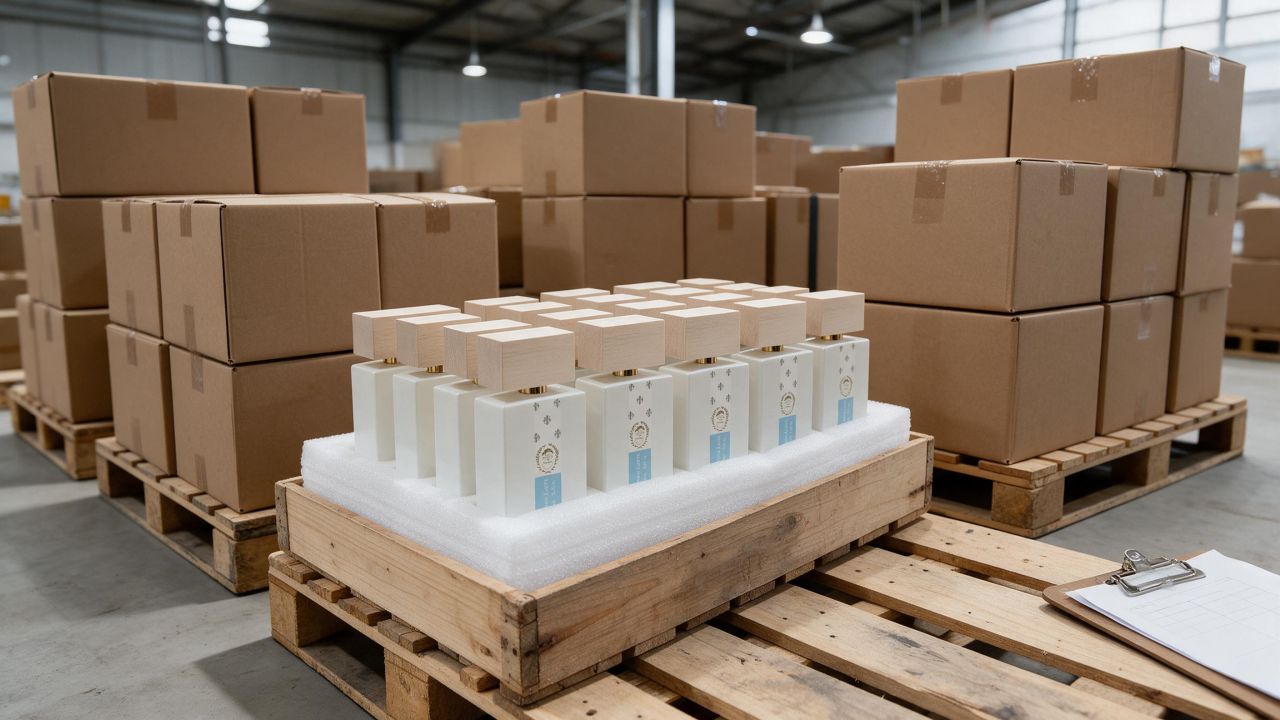
A wholesale distributor perfume supplier is a business that sells fragrance in bulk — by the case, pallet, or container — directly to retailers, importers, and other resellers rather than to individual shoppers. Working with one lets a retail or distribution business secure consistent stock, negotiate volume-based terms, and build a fragrance assortment without paying single-unit retail prices. For buyers, the real work is less about finding a seller and more about qualifying one: checking minimum order quantities, authentication practices, shipping capability, and after-sale support before committing to a purchasing relationship.
Summary
- A wholesale perfume distributor sells in bulk units (cases, pallets, containers) to businesses, not single bottles to end consumers.
- Minimum order quantities, tiered pricing, and mixed-case flexibility determine how accessible a supplier actually is for a given buyer size.
- Margins depend on order volume, packaging format, and how close the distributor sits to the manufacturer in the supply chain.
- Reliable sourcing requires verifying authenticity documentation, shipping/customs competence, and communication quality before the first large order.
What Does "Wholesale Distributor Perfume" Mean for B2B Buyers?

In the B2B fragrance trade, "wholesale distributor perfume" refers to inventory sold at bulk unit pricing to businesses that intend to resell it, not to private shoppers buying a single bottle for personal use. The distinction matters because the entire commercial relationship is built differently: contracts instead of checkout carts, invoices with payment terms instead of instant card charges, and recurring restocking instead of one-off purchases. A wholesale distributor typically operates somewhere between the manufacturer or brand owner and the retail shelf, holding inventory, managing logistics, and absorbing some of the risk that an individual retailer would otherwise have to carry alone.
For a retailer, distributor, or importer evaluating this model, the key questions are usually practical: how much stock has to be purchased at once, how fast can it be delivered, what happens if a shipment arrives damaged, and how transparent is the supplier about where the product actually comes from. None of these questions have a universal answer — they depend on the specific supplier's scale, region, and specialization — which is exactly why due diligence before the first order matters more in this category than in most consumer goods.
How the Wholesale Perfume Supply Chain Works
Understanding where a distributor sits in the supply chain helps a buyer judge pricing, lead times, and reliability. Fragrance generally moves through several possible layers before it reaches a retail shelf, and the number of layers directly affects both cost and control.
From Manufacturer to Distributor to Retailer
In the simplest version of the chain, a manufacturer or brand owner produces the fragrance and sells directly to a distributor, who then resells to retailers in smaller case quantities. Each additional layer — a secondary distributor, a regional agent, a marketplace intermediary — adds cost and reduces the buyer's visibility into product origin and freshness. Buyers who want tighter control over quality and pricing generally prefer to work with a distributor positioned as close to the source as possible, since fewer intermediaries usually means fewer opportunities for inconsistent batches or inflated markups.
Authorized vs. Independent Distribution Channels
Some wholesale perfume distributors operate as authorized partners of specific brands, with formal supply agreements and consistent access to current product lines. Others operate independently, sourcing from multiple manufacturers, closeout channels, or secondary markets. Neither model is automatically better — an independent distributor can often offer broader catalog variety and more flexible order sizes, while an authorized channel may offer stronger guarantees on authenticity and batch consistency. What matters for a buyer is knowing which model they are dealing with, since it changes what documentation and guarantees are reasonable to ask for.
Minimum Order Quantities and How They Shape Your Purchasing Strategy
Minimum order quantity, or MOQ, is usually the first practical filter a buyer runs into when approaching a wholesale perfume supplier. MOQs can be expressed in different ways — a minimum number of units per SKU, a minimum total order value, or a minimum number of cases — and the structure a supplier uses says a lot about how they operate.
A low per-SKU MOQ with flexible mixed-case ordering is generally friendlier to smaller retailers and newer importers who want to test multiple fragrances before committing to depth on any single one. A high MOQ per SKU, by contrast, usually signals a supplier built around larger distributors or chain accounts that can move volume on a narrower catalog. Neither structure is inherently wrong, but mismatching your business size against the wrong MOQ model is one of the most common early mistakes in wholesale fragrance sourcing — a small boutique retailer locking into container-level minimums can end up carrying dead stock for months, while a growing distributor stuck with unit-level minimums may never reach the pricing tiers that make the category profitable.
Before placing a first order, it is worth asking a supplier directly whether MOQs are negotiable for a trial order, whether assorted cases are allowed across different fragrances, and whether reorder quantities can scale down once a sales pattern is established. A supplier that can answer these questions clearly, without vague deflection, is usually one that has done this kind of business before.
Evaluating Profit Margins and Pricing Structures in Bulk Perfume Distribution
Margin in wholesale perfume distribution is a function of several variables stacked on top of each other, and no single number applies across the category. Buyers should think of margin as something they calculate for their specific sourcing arrangement rather than something a supplier can quote as a flat percentage.
Factors That Influence Wholesale Margins
The biggest margin driver is proximity to the source: a distributor buying closer to the manufacturer typically has more room to price competitively than one buying from a secondary wholesaler who already took a markup. Order volume is the second major factor — larger, consistent orders almost always unlock better unit economics than sporadic small ones. Packaging format also plays a role, since smaller formats carry different per-unit handling costs than larger ones, which affects how a supplier prices them relative to each other. Finally, payment terms matter: suppliers extending credit or flexible terms to a buyer often price slightly differently than those requiring full prepayment, since they are effectively financing part of the transaction.
Volume Tiers and Mixed-Case Ordering
Most wholesale perfume suppliers structure pricing in tiers tied to order volume, where crossing a quantity threshold unlocks a better unit rate. For buyers managing cash flow carefully, it is often smarter to negotiate a mixed-case arrangement — ordering a broader assortment of fragrances within one volume tier — rather than over-committing to a single SKU just to hit a price break. This approach protects against the risk of a slow-moving fragrance tying up working capital, while still letting the buyer reach the pricing tier that makes the overall order worthwhile. A supplier willing to structure tiers this way is generally easier to build a long-term purchasing relationship with than one that insists on single-SKU volume commitments.
Logistics, Shipping and Customs Considerations for Importers

Fragrance is classified as a regulated, often flammable liquid good for shipping purposes, which makes logistics meaningfully more complex than sourcing non-hazardous categories. Any business importing perfume at wholesale volume needs to plan for this from the first quote, not after the shipment is already booked.
Shipping Methods and Lead Times
Air freight moves faster but typically carries higher per-unit cost and stricter hazardous-goods handling requirements, which can affect both price and the carriers willing to accept the shipment. Sea freight is generally more cost-effective for larger container-level orders but requires longer lead times and more advance planning around inventory timing. Buyers should ask a prospective distributor directly which shipping methods they routinely use, how they package fragrance to meet carrier hazardous-materials rules, and what their average lead time looks like from order confirmation to port or warehouse arrival — vague answers here are a warning sign, since an experienced wholesale supplier should have this logistics information readily available.
Customs Documentation and Compliance
Importing perfume across borders usually requires correct commercial invoices, accurate harmonized system (HS) codes, safety data sheets, and sometimes additional documentation depending on the destination country's regulations on alcohol-based or flammable liquids. Errors in this paperwork are one of the most common causes of shipment delays and unexpected costs at the border. A distributor experienced in cross-border B2B fragrance trade should be able to provide complete, accurate export documentation without the buyer having to chase it down repeatedly — and should be transparent about which compliance responsibilities sit with the seller versus the importer of record on the buyer's side.
How to Vet and Choose a Reliable Wholesale Perfume Supplier
Because fragrance authenticity and consistency are harder for a buyer to verify at a distance than, say, a physical hard good, supplier vetting deserves more time than it typically gets. A few concrete checks go a long way toward reducing risk before committing to volume.
Authenticity, Batch Codes and Documentation
Ask whether products carry batch or lot codes, whether the supplier can explain the product's origin and sourcing chain, and whether they provide any documentation that supports authenticity claims. A supplier that answers these questions openly and consistently is a better long-term partner than one that treats the question defensively. It is also reasonable to request a small trial order before scaling up, specifically to inspect packaging quality, batch consistency, and condition on arrival.
Communication, Support and Reorder Flexibility
Beyond the product itself, evaluate how the supplier communicates: response times to inquiries, clarity around lead times and delays, and willingness to work through issues like a damaged shipment or a delayed container. A distributor that is easy to reach and straightforward about limitations is generally a safer long-term bet than one that overpromises during the sales conversation and underdelivers once the relationship is underway. Reorder flexibility is also worth confirming upfront — how easily can quantities adjust up or down as your own sales data comes in, and is there room to shift the SKU mix between orders based on what is actually selling.
Product Formats and Assortment Planning for Retailers and Distributors

A well-planned wholesale assortment balances format variety against the realities of shelf space, price positioning, and customer demand patterns. Buyers sourcing for a multi-brand retail floor or a distribution catalog generally benefit from mixing formats rather than committing an entire order to a single size.
Smaller formats, such as 38ml bottles, work well for impulse purchases, gift-with-purchase promotions, and travel-focused retail, while 50ml bottles sit in the middle ground that often performs as a core, everyday retail size. For buyers looking to differentiate their catalog from mass-market competitors, niche perfume lines can anchor a premium section of the assortment, appealing to customers who are actively seeking something beyond the mainstream designer names already saturating most retail shelves. Bundled formats such as a curated perfume set also give distributors a gifting-season or promotional option without needing to source and package components separately.
When planning assortment depth, it is worth mapping out which formats and categories move fastest in your specific market before locking in order quantities. A distributor that can speak knowledgeably about which combinations of size, concentration, and category tend to perform well for different types of retail accounts is a more useful long-term sourcing partner than one that simply fulfills whatever is requested without input.
Frequently Asked Questions
What is the difference between a wholesale perfume distributor and a retailer?
A wholesale distributor sells in bulk to businesses that intend to resell the product, while a retailer sells individual units directly to end consumers. Distributors typically operate with volume-based pricing tiers, invoiced payment terms, and case or pallet-level order structures, whereas retail transactions are single-unit and immediate.
How do I verify that a wholesale perfume supplier sells authentic product?
Ask for batch or lot code information, request documentation that supports the product's origin, and consider placing a small trial order before committing to larger volume. Suppliers that answer sourcing questions clearly and consistently, rather than deflecting them, are generally more trustworthy partners.
What shipping method is best for importing wholesale perfume?
It depends on order size and timeline. Air freight is faster but more expensive per unit and subject to stricter hazardous-goods handling, while sea freight is more cost-effective for larger container-level orders but requires longer advance planning. The right choice depends on your inventory timeline and order volume.
Can I negotiate minimum order quantities with a wholesale perfume distributor?
Many distributors allow some flexibility, particularly for a first trial order or when a buyer agrees to a mixed-case assortment across multiple fragrances instead of committing deeply to a single SKU. It is reasonable to ask directly whether MOQs can flex for a new account relationship.