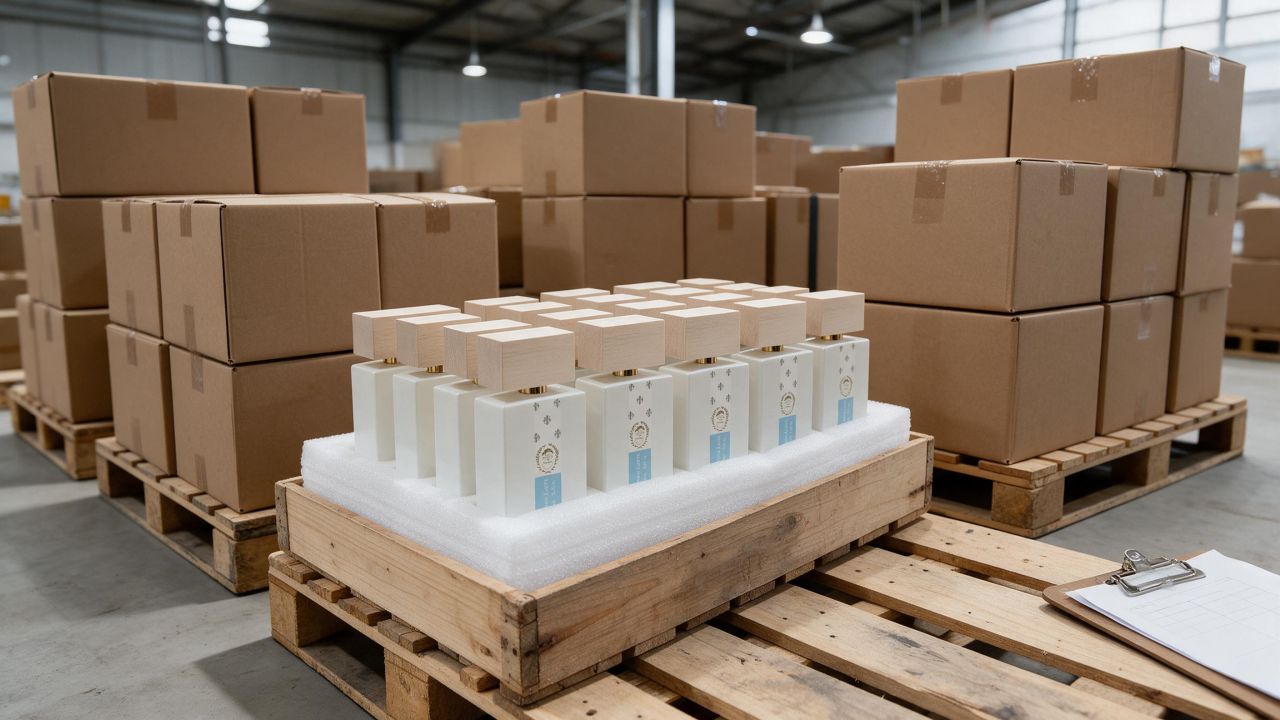
Wholesale branded perfume means buying authentic, name-brand fragrances — designer or niche — in bulk from a verified distributor or wholesale supplier, rather than single retail units off a shop shelf. For a retailer, importer, or distributor, that typically involves case-pack or carton-level minimum order quantities, documented sourcing (invoice, packing list, batch information), and pricing that leaves room for resale margin. The fastest way to start is matching your sales channel — retail counter, e-commerce store, or regional distribution — to a supplier who can prove authenticity and support repeat ordering, not a one-off “stock lot” deal.
Summary
- Wholesale branded perfume means authentic designer or niche fragrance bought in bulk from a vetted supplier, with real documentation — not generic “stock lot” perfume.
- Minimum order quantities are usually set per case or per carton, and mixed-SKU cartons let smaller buyers diversify without over-committing to one fragrance.
- Because perfume contains flammable alcohol, shipping and customs classification differ from ordinary cosmetics — plan freight mode and paperwork before you order.
- Supplier due diligence (verifiable invoices, trial orders, clear tester-vs-retail-box labeling) matters more than chasing the lowest quoted price.
What “Wholesale Branded Perfume” Actually Means for a B2B Buyer
When buyers search for wholesale branded perfume, they are usually trying to separate three very different offers that get marketed under the same label. The first is authentic designer and niche perfume sold in its original retail packaging, sourced through an authorized channel and resold in bulk. The second is the tester format — the same fragrance, same concentration, same batch sourcing, packaged in a plain or shrink-wrapped box without the branded outer carton, sold at a lower wholesale unit cost precisely because the packaging is simplified. The third, and the one professional buyers need to screen out, is unverified “stock” perfume: product with no traceable batch code, inconsistent fill levels, or packaging that does not match the brand's current line — sometimes diverted, sometimes counterfeit, sometimes simply closeout stock sold without disclosure.
For a retailer, distributor, or importer building a catalog, “branded” is the operative word. It means the liquid, the concentration, and the bottle correspond to what the brand actually manufactures — whether that arrives in full retail dress or tester packaging — and that the supplier can show where it came from. That distinction matters more than the format. A tester-boxed fragrance from a documented source is still wholesale branded perfume; a retail-boxed fragrance from an undocumented source is a liability waiting to surface as a customer complaint, a marketplace suspension, or a customs hold.
Why Branded Stock Outperforms Generic or Unverified Perfume

Brand recognition does commercial work that no amount of margin on an unbranded alternative can replace. A buyer stocking a known house — whether a mainstream designer name or an established niche label — inherits existing demand: customers already search for the name, already have a scent memory or aspiration attached to it, and already trust the packaging enough to buy without smelling it first, which matters enormously for online and cross-border retail. Generic or unbranded “compatible” fragrances require the retailer to build that trust from zero, usually by competing on price alone.
Branded stock also tends to generate fewer post-sale disputes. Authentic product performs consistently batch to batch, which keeps return rates and complaint volume low — a real cost line for any B2B buyer running a storefront or marketplace account, where return rates affect account standing as much as revenue. Because branded perfume is recognizable, it is also easier to merchandise: a multi-brand catalog page, a comparison table, or a marketplace listing all perform better when the product name itself is doing part of the selling.
None of this requires buying only flagship, highest-turnover names. A well-built wholesale catalog mixes a handful of fast-moving, instantly recognizable SKUs with a longer tail of niche or less mainstream branded fragrances that carry higher margin and less price competition, precisely because fewer competitors stock them.
Minimum Order Quantities and How They Shape Your First Order
Minimum order quantity, or MOQ, is the first practical constraint any wholesale branded perfume buyer runs into, and it is set at the supplier level, not the brand level — different wholesalers covering the same brand can set very different thresholds. The most common structures are a per-SKU case pack (a fixed unit count of one fragrance and size), a mixed carton (a set unit count that can be split across several SKUs within the same size or packaging format), and a pallet or container minimum for buyers ordering at distribution scale.
For a first order, a mixed carton is almost always the more sensible entry point than committing a full case to a single fragrance you have not sold before. It lets a retailer test market response across several SKUs — say, two or three designer names and one niche line — without concentrating capital in a product that may or may not move at your price point and in your region. As sell-through data comes in, buyers typically graduate to single-SKU case orders for the names that performed, and keep the mixed-carton approach for anything speculative or seasonal.
MOQ also interacts directly with unit cost: suppliers generally reward volume with better per-unit pricing, which means the lowest advertised wholesale price is rarely available at the smallest order size. Before requesting a quote, it helps to know roughly which quantity tier you are actually able to commit to, since that number — not the brand name — is what the supplier will price against.
The Supply Process, Step by Step: Inquiry to Delivery

A wholesale branded perfume order generally moves through the same sequence regardless of supplier, and knowing the steps in advance helps a buyer spot a supplier that skips or rushes any of them:
- Catalog and price list request. You submit your business details and receive available SKUs, current wholesale pricing tiers, and MOQ per item or carton.
- SKU and quantity selection. You build an order across single-SKU cases and mixed cartons, balancing recognizable names against niche or higher-margin lines.
- Quotation and terms. The supplier issues a formal quote or proforma invoice covering unit price, total order value, payment terms, and estimated lead time.
- Payment and confirmation. Once terms are accepted and payment is arranged, the order is confirmed and moves into picking and packing.
- Documentation. A commercial invoice and packing list are prepared — these are the documents your freight forwarder and customs broker will need on the receiving end.
- Shipping. The order is dispatched by the agreed freight mode: courier, air freight, or sea freight, depending on order size and urgency.
- Arrival and quality check. On receipt, buyers should reconcile the shipment against the packing list and spot-check batch codes and fill levels before the stock goes into inventory or onto a sales channel.
The steps that lower-quality suppliers most often compress are documentation and the pre-shipment quality check — exactly the two steps that protect a buyer if a dispute arises later. A supplier that readily provides a detailed packing list and itemized invoice without being asked twice is signaling a process built for repeat B2B business, not one-off sales.
Margins and Positioning: Making Wholesale Perfume Profitable
Margin structure in wholesale branded perfume is shaped by three variables: the brand's market position, the packaging format, and the sales channel you are reselling into. Mainstream designer names typically move at higher volume but thinner per-unit margin, because end-customer price expectations are well established and competition among resellers is visible and constant. Niche and newer luxury houses carry less price transparency, which usually supports a healthier margin, at the cost of slower, less predictable turnover.
Tester-format stock is where many B2B buyers find their best entry-level margin, because the lower acquisition cost of tester packaging does not always translate into an equally lower resale price once the buyer frames it correctly — as the same fragrance and concentration, simply without retail dress — for a customer base of value-conscious collectors and bulk buyers.
Positioning also depends on the channel. A storefront or marketplace listing competing directly against a brand's own retail price needs a visibly different value proposition — bulk pricing, tester format, or bundle deals — rather than trying to match a single-unit retail price point. A B2B-to-B2B distributor, by contrast, is usually pricing against other wholesalers' quotes rather than the brand's own retail shelf, which rewards consistent supply and reliable lead times over the lowest possible unit price.
Either way, margin planning should start from your actual landed cost — unit price plus freight, duties, and any payment or currency conversion fees — rather than the wholesale quote in isolation.
Logistics, Customs, and Cross-Border Shipping
Perfume is not logistically neutral cargo. Because most fragrances are alcohol-based, many carriers classify them as a flammable liquid — commonly referenced under dangerous-goods rules for air and road transport — which restricts shipping method, packaging, and sometimes volume per shipment. Sea freight generally faces fewer restrictions than air freight for this reason, but takes considerably longer, which matters when you are sizing a first order against cash flow.
On the customs side, a wholesale perfume shipment needs a correct harmonized system code, an accurate commercial invoice reflecting the real transaction value, and a packing list itemizing SKUs and quantities. Import duties, VAT, or other local taxes are typically the buyer's responsibility on arrival, and they vary by destination country and sometimes by product category within cosmetics, so it is worth confirming the expected landed-cost impact before committing to an order size.
For buyers new to importing fragrance specifically, working with a freight forwarder or customs broker who has handled cosmetics or dangerous-goods cargo before is worth more than shopping purely on freight rate — a shipment held at customs for missing or inconsistent paperwork costs far more in delay and storage fees than the freight savings from a cheaper, less experienced forwarder. Confirming in advance which Incoterm your supplier ships under also clarifies exactly where responsibility, and cost, shifts from supplier to buyer.
How to Vet a Reliable Wholesale Branded Perfume Supplier

Price is the easiest thing to compare between suppliers and the least reliable signal of whether an order will go smoothly. A more useful due-diligence checklist for a new B2B relationship includes:
- Verifiable business identity — a registered company, a real physical address, and a sales contact who answers specific questions about sourcing rather than only about price.
- Clear tester-versus-retail-box labeling on every SKU, with no ambiguity about what packaging format you are actually buying.
- Willingness to share batch or sourcing information on request, rather than treating the question as unusual or unwelcome.
- Consistent documentation — invoices and packing lists that match what is actually shipped, not just a generic template.
- A reasonable first-order path — a supplier confident in their stock will usually accommodate a smaller trial order or mixed carton before expecting a buyer to commit to a large single-SKU case.
- A defined policy for damage or discrepancy claims, agreed before payment rather than negotiated after a problem appears.
A trial order is the single best diligence step available, and it is worth treating as a real test rather than a formality: check batch codes against the brand's own format where possible, confirm fill levels, and see how the supplier handles any discrepancy before scaling order size. Suppliers that are genuinely set up for repeat B2B business tend to welcome this, since it is exactly how they turn a first-time buyer into a recurring account.
Building a Balanced Catalog: Designer, Niche, and Tester SKUs
A catalog built entirely around one fragrance family or one price tier is fragile — it over-indexes on a single customer taste and leaves no room to adjust if demand shifts. A steadier approach mixes a few distinct profiles so the catalog can answer different buyer requests without constant re-sourcing.
A gourmand, oriental-leaning SKU covers customers looking for something rich and distinctive rather than a mainstream citrus or aquatic profile — the Kilian Intoxicated EDP 50ml Tester Parfüm is a useful anchor in that niche-luxury segment, appealing to buyers whose end customers already look beyond mass designer names.
For a bolder, more assertive profile aimed at a customer who wants a fragrance with real presence, a tobacco-leather composition such as the Mancera Red Tobacco EDP 120ml Tester Parfüm rounds out the catalog with a distinct, less price-transparent niche option.
On the designer side, a recognizable men's fragrance with strong existing brand recall — the Jean Paul Gaultier Le Male Elixir Parfum 125ml Tester Parfüm — gives a catalog the kind of instantly recognizable SKU that drives traffic and conversion on its name alone, balancing the slower-moving niche lines.
A gourmand vanilla composition positioned toward a more daring, maximalist niche aesthetic, like the Tom Ford Vanilla Sex EDP 100ml Tester Parfüm, adds a high-recognition luxury name with a very different olfactive angle from the first two.
Keeping all four in tester format rather than full retail packaging lowers the capital required to stock this spread, while still giving end customers the genuine fragrance and concentration they are paying for — which is the core trade-off that makes tester-based wholesale catalogs work for smaller and mid-size B2B buyers specifically.
Working with Beyazit Parfum (EN) for Wholesale Branded Perfume
Beyazit Parfum (EN) operates as a wholesale-focused source for retailers, distributors, and importers who need documented, branded fragrance stock rather than ambiguous bulk lots. The catalog spans designer and niche houses in both tester and retail formats, which gives buyers the flexibility to build exactly the kind of mixed, margin-balanced catalog described above — a handful of high-recognition designer SKUs alongside niche lines that carry less price competition.
For a buyer evaluating a new supplier relationship, the practical next step is the same regardless of where you are sourcing from: request the current catalog and wholesale pricing, confirm MOQ at the carton or case level, and place a trial order sized to test sell-through before committing to a larger single-SKU case. Treat the first order as due diligence as much as a purchase — the way a supplier handles documentation, communication, and any discrepancy on that first shipment tells you more about the relationship than any price list on its own.
Frequently Asked Questions
What is the minimum order quantity for wholesale branded perfume?
MOQ varies by supplier rather than by brand, and is usually set either per single-SKU case or per mixed carton that can be split across several fragrances. Buyers placing a first order typically find a mixed carton the more practical starting point, since it limits exposure to any one SKU while still meeting the supplier's minimum.
Are tester bottles considered genuine branded perfume?
Yes. A tester is the same fragrance, concentration, and batch sourcing as the retail-boxed version, packaged in simplified outer dress rather than the brand's full retail carton. The liquid and bottle are unchanged; only the outer packaging is reduced, which is also why testers are typically priced lower at wholesale.
How long does international shipping take for wholesale perfume orders?
Timing depends heavily on freight mode, since fragrance is commonly classified as a flammable liquid for transport purposes. Sea freight is slower but faces fewer shipping restrictions, while air freight is faster but more tightly regulated and often costlier per unit for this category — buyers usually choose based on order size and how urgently the stock needs to reach their market.
Can I mix brands and sizes in a single wholesale order?
Most suppliers that sell through mixed cartons allow combining different brands and sizes within that carton's minimum unit count, which is precisely what makes mixed cartons useful for testing several SKUs at once. Single-SKU case packs, by contrast, are generally locked to one fragrance and size per case.