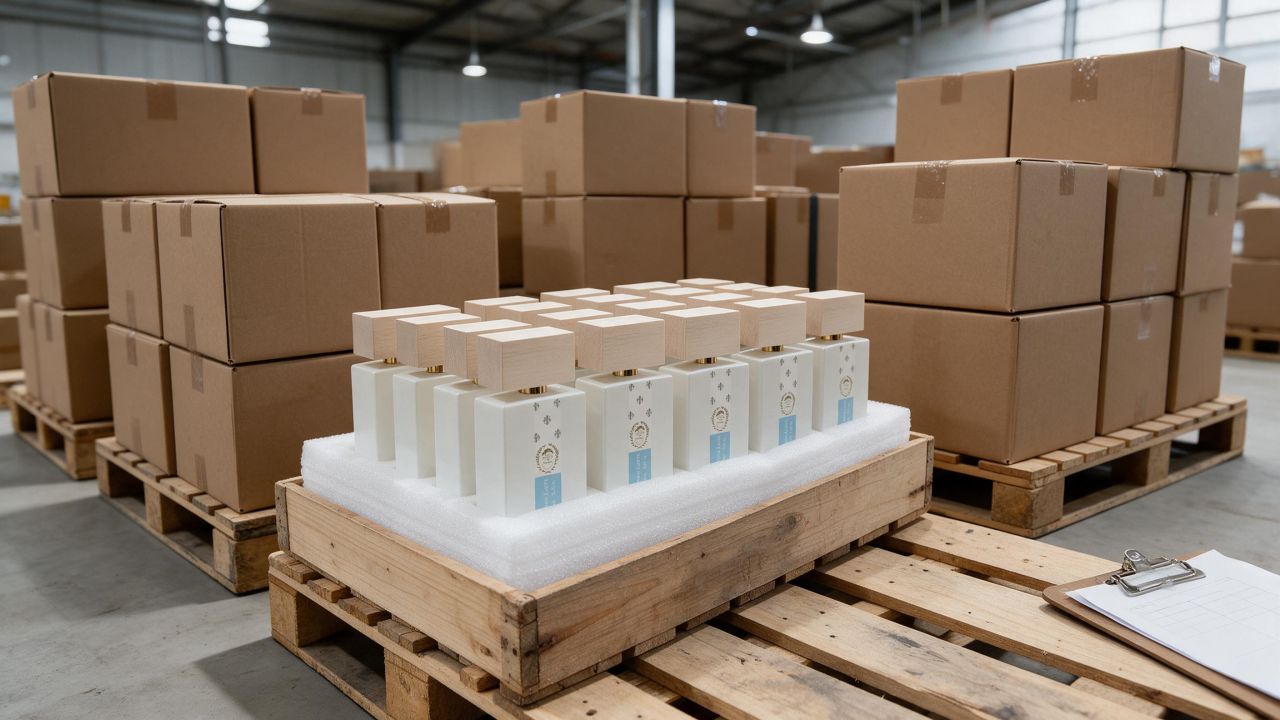
Perfume wholesale distributors are B2B suppliers that sell fragrances in bulk, typically by the case, carton, or pallet, to retailers, duty-free operators, online resellers, and regional importers at volume-based pricing rather than single-unit retail. A dependable distributor combines verified product sourcing, clearly stated minimum order quantities, consistent stock availability, and documented export and customs support so a buying business can resell with confidence. For most wholesale buyers, the right partner is chosen less on unit price alone and more on supply consistency, authenticity guarantees, and logistics reliability.
Summary
- Perfume wholesale distributors stock and ship multi-brand fragrance catalogs in bulk, differing from single-brand agents or manufacturers that sell direct to one retailer at a time.
- Vetting a distributor means checking authenticity documentation, minimum order quantity structure, warehouse capacity, and export compliance before placing a first order.
- Margin planning should be built around landed cost, including freight, duty, and insurance, rather than the quoted wholesale unit price alone.
- A diversified assortment across pack sizes, gift sets, and niche fragrance lines helps a retail or distribution partner serve multiple shelf price points at once.
What Are Perfume Wholesale Distributors?
A perfume wholesale distributor is a company that purchases finished fragrances directly from brand owners, licensed manufacturers, or authorized regional agents, then resells those fragrances in bulk to downstream businesses. Unlike a single-brand sales office, a distributor typically carries a multi-brand catalog spanning designer-style eau de parfum and eau de toilette lines, gift sets, and travel formats, which lets a buying business source a broad assortment from one account instead of negotiating with dozens of individual brand owners.
The buyers who rely on wholesale distributors include independent perfume and cosmetics retailers, pharmacy and drugstore chains, supermarket and discount retail buyers, duty-free and travel-retail operators, online marketplace sellers, gift shop owners, and regional sub-distributors who break bulk shipments down further for their own domestic customers. What all of these buyers have in common is that they are purchasing inventory to resell, not to use personally, so their priorities center on consistent supply, predictable lead times, and documentation that supports resale in their own market.
A distributor's value is not limited to holding stock. Established distributors also absorb a meaningful share of sourcing risk for their buyers: they vet manufacturing batches, manage returns and damaged-goods claims with the upstream brand, and consolidate multiple SKUs into a single shipment, which reduces the administrative load on a retailer or importer that would otherwise need to manage dozens of separate supplier relationships.

How Perfume Wholesale Distributors Differ from Manufacturers, Brand Agents, and Dropshippers
Buyers new to fragrance sourcing sometimes confuse distributors with manufacturers or single-brand agents, but the business models serve different purposes. A manufacturer produces the fragrance and packaging; it may sell direct to very large accounts, but it rarely services the order sizes or mixed-brand catalogs that small and mid-sized retailers need. A brand agent typically represents one brand or one group of brands within a defined territory, which means a buyer who wants variety across dozens of fragrance lines still has to open and manage multiple agent accounts separately.
A wholesale distributor, by contrast, aggregates inventory from many brands and manufacturing sources into one catalog, holds physical stock rather than sourcing on demand, and is generally equipped to ship mixed-SKU orders on a repeatable schedule. This matters most for buyers who need to restock regularly: a distributor with its own warehouse can usually confirm availability and ship faster than an agent who has to request stock from a brand's production schedule.
Dropshipping arrangements sit at the opposite end of the spectrum. A dropship supplier may advertise a wide catalog without holding meaningful stock, which creates risk for a B2B buyer whose own customers expect reliable delivery windows. For any buyer planning recurring wholesale purchases rather than one-off trial orders, a distributor model with verifiable warehouse stock is the lower-risk choice.
What to Look for When Vetting a Perfume Wholesale Distributor
Because wholesale buyers are placing recurring orders against their own resale commitments, due diligence on a prospective distributor should happen before the first purchase order, not after a shipment problem. The following criteria cover the areas that most commonly separate dependable partners from risky ones.
Product Authenticity and Documentation
Ask any prospective distributor how they source their inventory and whether they can provide invoices, batch information, or certificates that trace a shipment back to a licensed source. A distributor that is transparent about sourcing and willing to document authenticity is signaling that it expects its own customers to resell with confidence, which protects a retailer's reputation with its end customers and reduces the risk of disputes over counterfeit claims.
Minimum Order Quantities and Order Flexibility
Every distributor sets a minimum order quantity, often structured by case pack, carton, or total order value rather than by single unit. Before committing, confirm whether the MOQ applies per SKU or across a mixed order, and whether smaller trial orders are available for a buyer testing a new fragrance line before committing to a larger repeat order.
Warehouse Capacity and Stock Consistency
A distributor's warehouse capacity determines whether it can support recurring restocking without frequent backorders. Ask about typical stock turnover for the lines you intend to carry, and whether the distributor can commit to a restocking cadence that matches your own sales cycle, particularly ahead of seasonal demand peaks such as holiday gifting periods.
Export, Customs, and Compliance Support
If you are importing across a border, confirm that the distributor can provide the paperwork customs will require, including commercial invoices, packing lists, and any safety documentation specific to alcohol-based fragrance products. A distributor experienced in cross-border B2B trade should be able to explain this process clearly rather than treating it as the buyer's problem alone.
Minimum Order Quantities, Tiered Pricing, and Margin Planning
Wholesale pricing for fragrances is almost always tiered: larger case-pack or pallet-level orders unlock better unit economics than small trial orders, and distributors frequently offer better terms to buyers who commit to a recurring order schedule rather than placing sporadic one-off purchases. For a buying business, the practical takeaway is to plan assortment and order size together. Ordering a narrower range of SKUs at higher volume per SKU is usually more favorable than spreading a small total order across many different fragrances, because it is easier to reach a favorable pricing tier and easier for the distributor to guarantee consistent batch quality.
Margin planning should be based on landed cost, not the wholesale quote alone. Landed cost includes the unit price, inbound freight, any import duty or tariff applicable to the destination market, insurance, and the cost of final-mile distribution to your own customers. Two distributors quoting similar unit prices can produce very different margins once freight terms, payment terms, and minimum order thresholds are factored in, so it is worth comparing full landed-cost estimates rather than unit price in isolation.
It is also worth asking how a distributor handles price changes and order amendments. Fragrance wholesale pricing can shift with currency movement, raw material costs, or brand-side list price updates, so a distributor that communicates pricing changes in advance, rather than adjusting invoices after the fact, is easier to plan a retail or resale calendar around.
Building a Profitable Wholesale Assortment: Formats, Sets, and Niche Lines
A well-balanced wholesale order typically mixes formats rather than committing entirely to one pack size. Smaller formats support impulse and travel-retail price points, while larger bottles serve customers who already know and prefer a specific fragrance and are buying for longer-term personal use. Distributors that carry a range of formats, such as 38ml perfume formats alongside 50ml perfume bottles, make it easier for a retail buyer to stock a single brand across multiple shelf price points instead of being locked into one size per SKU.
Gift-oriented SKUs deserve a place in most wholesale assortments as well. Curated perfume sets tend to perform strongly around gifting seasons and in travel-retail or duty-free environments, where a packaged set with complementary pieces often converts better than a single bottle at the same price point. For buyers targeting a more discerning or boutique customer base, adding niche perfume collections alongside mainstream designer-style lines broadens the catalog's appeal without requiring a separate supplier relationship.
The right assortment mix ultimately depends on the buyer's own channel: a duty-free operator will weight travel formats and sets more heavily, while an online marketplace reseller may prioritize full-size bottles with strong individual search demand. A distributor that can advise on assortment strategy for your specific channel, rather than simply fulfilling whatever is ordered, is a useful long-term sourcing partner.

Logistics, Customs, and Lead Times for Cross-Border Wholesale Buyers
Fragrances are classified as flammable goods because of their alcohol content, which affects how they can be shipped and what documentation is required. Air freight shipments typically require dangerous-goods handling and declarations, while sea freight is generally more cost-effective for larger volume orders but comes with longer transit times that need to be planned into a restocking calendar well in advance. A distributor experienced in international B2B shipping should be able to advise which shipping method fits a given order size and delivery deadline.
Customs clearance for fragrance imports usually requires a commercial invoice, a packing list, the correct harmonized system (HS) code for classification, and in many markets a certificate of origin or safety data sheet referencing the alcohol content. Import duty and any applicable taxes are calculated against the declared customs value, so buyers should confirm with the distributor exactly what will appear on shipping documentation before the order ships, rather than discovering discrepancies at the border.
Lead time planning should account for production or stock-pull time at the distributor's warehouse, transit time for the chosen shipping method, and customs clearance time at the destination, which can vary depending on the importer's own compliance history and the completeness of the paperwork. Buyers who are new to importing fragrances, or who are entering a new destination market, generally benefit from working with a distributor that offers guidance on compliance rather than simply handing off a shipment and leaving the import process entirely to the buyer.

Red Flags That Signal an Unreliable Wholesale Supplier
Not every company advertising wholesale fragrance supply is equipped to serve a recurring B2B relationship responsibly. A few warning signs are worth treating seriously during supplier evaluation. A supplier that cannot produce any business registration, verifiable contact details, or trade references should raise immediate caution, since legitimate distributors generally have no reason to hide this information from a prospective business customer.
Reluctance to provide sourcing documentation or certificates of authenticity is another signal worth taking seriously, particularly for a buyer that will need to answer authenticity questions from its own customers later. Similarly, a supplier that pressures full prepayment with no written order confirmation, no defined return policy for damaged goods, and no clear communication channel for order issues is taking on very little accountability for its own fulfillment.
Finally, pricing that sits dramatically below the rest of the market for the same brand and format is worth investigating rather than celebrating. It can sometimes reflect genuine overstock or close-out inventory, but it can also indicate diverted, expired, or counterfeit stock. Comparing quotes across a few distributors, rather than defaulting to the single lowest price, is a reasonable way to sanity-check an unusually aggressive offer before committing to a larger order.
Frequently Asked Questions
What is a typical minimum order quantity for perfume wholesale?
Minimum order quantities vary by distributor and are usually structured around case packs or a minimum order value rather than a single bottle, and many distributors offer a smaller trial-order tier for buyers evaluating a new fragrance line before committing to a larger recurring order.
Can perfume wholesale distributors ship internationally?
Many distributors do ship across borders, but because fragrances are classified as flammable goods, buyers should confirm the distributor's experience with dangerous-goods documentation, the available shipping methods, and the customs paperwork that will accompany the shipment before placing an international order.
How do I verify that a perfume wholesale distributor is legitimate?
Ask for verifiable business registration details, request documentation that traces products back to a licensed source, and check whether the distributor is willing to put order terms, pricing, and a return policy in writing before you commit to a first purchase.
Do wholesale distributors carry both designer and niche fragrances?
Established distributors commonly carry a mix of designer-style fragrance lines alongside niche or boutique collections, along with gift sets and multiple bottle sizes, which allows a retail or distribution buyer to source a varied assortment from a single account.